
Boston, MA – November 11, 2025 – In a landmark decision underscoring the delicate balance between federal oversight and academic freedom, U.S. District Judge Allison Burroughs has ordered the restoration of critical federal funding to Harvard University, including grants designated for groundbreaking cancer research. The ruling, issued in September 2025, deems the Trump administration’s earlier termination of over $2.2 billion in grants unlawful, citing ongoing disputes over the university’s handling of antisemitism and Diversity, Equity, and Inclusion (DEI) programs following the 2023 Hamas attacks on Israel.
The court’s intervention reinstated approximately $46 million in grants, providing a vital lifeline to key scientific projects. Among the beneficiaries is Harvard researcher Joan Brugge, whose work at the Ludwig Center for Functional Cancer Genomics focuses on breast cancer prevention. Brugge’s research, which receives $1 million annually through the restored funding, aims to develop innovative strategies to halt the progression of breast cancer at its earliest stages, potentially saving countless lives. A prominent figure in oncology with decades of experience, Brugge described the initial funding cut as a “gut punch” that threatened to derail years of progress in her lab.
The controversy traces back to May 2025, when the Trump administration, citing alleged failures by Harvard to adequately address antisemitic incidents on campus after the 2023 attacks, moved to freeze billions in federal research dollars. The action was part of a broader campaign against DEI initiatives, which critics argued prioritized ideology over merit. Harvard officials vehemently denied the accusations, asserting that the cuts violated constitutional protections and jeopardized national health priorities.
In response, Harvard filed a lawsuit arguing that the termination was arbitrary and politically motivated, infringing on First Amendment rights and the Administrative Procedure Act. The university warned that the cuts threatened critical research in cancer, fertility, and antibiotics, potentially setting back scientific progress by years. To mitigate immediate impacts, Harvard allocated $250 million of its own funds in May 2025 to sustain ongoing projects but emphasized that federal support remained essential for long-term innovation.
Hearings began in July 2025, with Harvard presenting evidence of the “wasteful” consequences of the funding freeze, including halted clinical trials and disrupted collaborations. The administration defended its actions as necessary enforcement against discrimination, but Judge Burroughs ultimately sided with the university, ruling the termination unconstitutional and ordering the funds’ release.
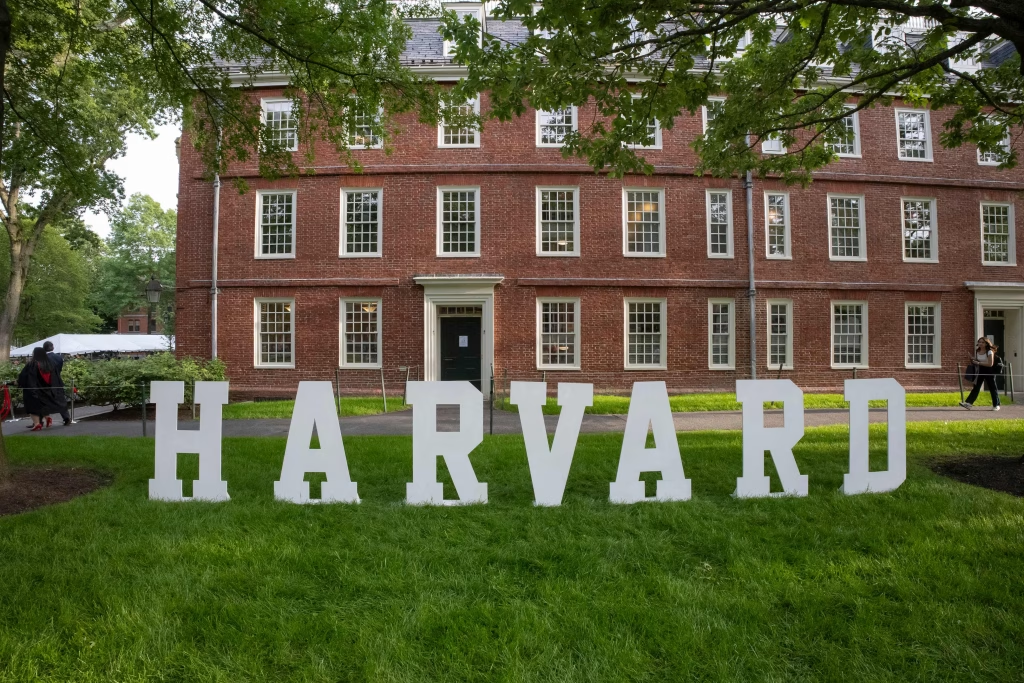
This ruling not only revives Harvard’s research pipeline but also sets a precedent for how federal agencies can use funding as leverage in ideological disputes. Experts in higher education policy note that the decision highlights the tension between government accountability measures and the need for uninterrupted scientific inquiry—especially in public health fields where delays can have life-or-death consequences.
For Brugge’s team, the restored funding allows them to resume experiments that could lead to preventive therapies for breast cancer, a disease affecting millions worldwide. “This work has the potential to prevent breast cancer altogether,” Brugge said in a recent interview, emphasizing the human stakes involved.
The Trump administration has indicated plans to appeal the decision, potentially escalating the case to higher courts. As the legal battle continues, the scientific community watches closely, hoping for stability in the funding that sustains America’s leadership in medical innovation.


