
Washington, D.C. – January 20, 2025 – In a move that has sparked international debate and reshaped America’s role in global health governance, the United States has officially exited the World Health Organization (WHO) following President Donald Trump’s signing of Executive Order 14155. The order, enacted on Inauguration Day, restarts and finalizes a withdrawal process that was initially paused during the previous administration, fulfilling Trump’s longstanding campaign promise to hold the WHO accountable for what he described as “catastrophic missteps” during the COVID-19 pandemic.
The executive order directs the immediate cessation of all U.S. funding to the WHO, leaving an estimated $260 million in unpaid dues unresolved. Prior to the withdrawal, American contributions accounted for 18–22% of the organization’s annual budget, making the U.S. its largest single donor. Secretary of State Marco Rubio and Health and Human Services Secretary Robert F. Kennedy Jr. issued a joint statement emphasizing the decision’s rationale. “The WHO’s politicized agenda and repeated obstructions during the COVID-19 crisis undermined global trust and failed to promote transparency,” the statement read. “This withdrawal allows us to redirect resources toward bilateral partnerships that better serve American interests and global health security.”
Supporters of the move, including many within the Republican Party and conservative advocacy groups, have praised it as a bold rejection of “globalism” and an assertion of U.S. sovereignty. “For too long, we’ve poured billions into an organization that kowtowed to China and bungled the biggest health crisis in a century,” said Senator Ted Cruz (R-TX) in a tweet following the announcement. Proponents argue that the U.S. can achieve more through direct collaborations with allied nations and private-sector initiatives, potentially focusing on areas like vaccine development and pandemic preparedness without the bureaucratic hurdles of the WHO.
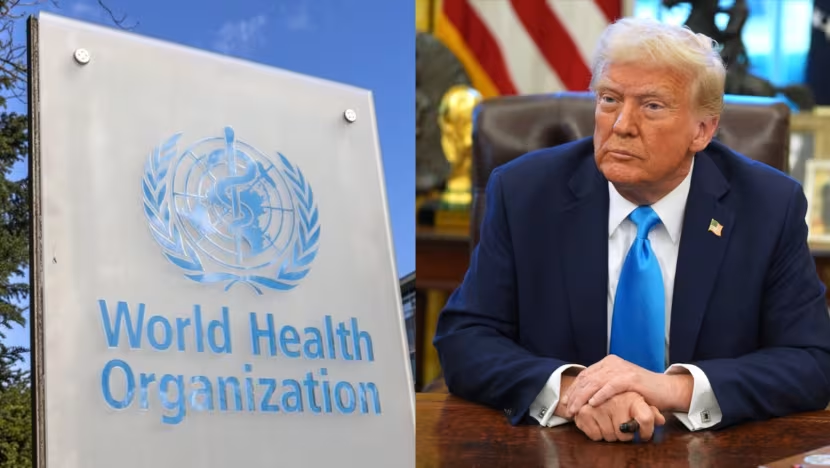
Critics, however, have voiced strong concerns about the potential repercussions. Public health experts and Democratic leaders warn that exiting the WHO could severely hamper international disease surveillance and response efforts. “This is a dangerous step backward,” said former WHO advisor Dr. Ashish Jha in an interview with CNN. “The U.S. loses access to critical early-warning systems for outbreaks, and the world loses our expertise and funding. In an interconnected world, isolationism in health policy is shortsighted and risky.” Organizations like Doctors Without Borders have echoed these sentiments, highlighting the WHO’s role in coordinating responses to ongoing threats such as Ebola, mpox, and emerging variants of respiratory viruses.
The administration has outlined plans to pivot toward alternative frameworks, including strengthened ties with G7 health initiatives and new bilateral agreements with countries like the United Kingdom, India, and Israel. Officials have also signaled interest in reforming or creating a new international health body that emphasizes accountability and depoliticization.
This withdrawal marks the culmination of tensions that began in 2020, when Trump first announced intentions to leave the WHO, accusing it of bias toward China and inadequate transparency regarding the origins of COVID-19. The process was halted by President Joe Biden upon taking office in 2021, but Trump’s return to the White House has revived and accelerated it.
As the dust settles, global leaders are watching closely. WHO Director-General Tedros Adhanom Ghebreyesus expressed regret in a statement, urging the U.S. to reconsider: “Health knows no borders. We hope for continued collaboration in some form to protect all humanity.” Meanwhile, the U.S. stock market showed mixed reactions, with pharmaceutical companies like Pfizer and Moderna seeing slight gains amid speculation of increased domestic funding for health research.


