
Washington, D.C. – November 6, 2025 – In a bold foreign policy move, President Donald Trump has officially designated Nigeria as a “Country of Particular Concern” (CPC) due to severe violations of religious freedom, particularly the targeted persecution of Christians by radical Islamist groups.
The announcement, made on November 5, 2025, revives a policy from Trump’s first term that was reversed under President Joe Biden. It also includes directives for the Pentagon to prepare contingency plans for potential military intervention should the Nigerian government fail to address the crisis.
The designation follows alarming reports of widespread violence against Christian communities in Nigeria. Advocacy groups have documented more than 7,000 Christian deaths in 2025 alone. Trump cited “radical Islamist violence” as the primary cause, accusing elements within Nigeria of enabling or ignoring attacks by groups such as Boko Haram and Fulani militants.
“We cannot stand by while innocent Christians are slaughtered by the thousands,” Trump declared during a White House press briefing. “If Nigeria doesn’t step up, America will be ready to act to protect religious freedoms and human lives.”
This decision has received strong support from U.S. conservatives and religious advocacy organizations, including the Family Research Council and Open Doors USA, both of which have long warned of Nigeria’s deteriorating security situation.
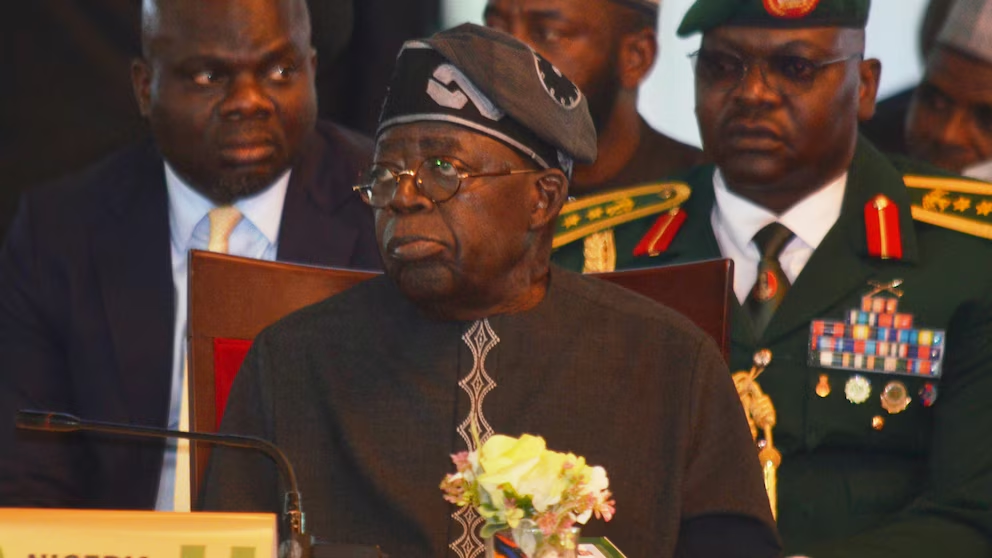
“This is a crucial step toward holding accountable those who perpetrate or permit genocide against Christians,” said Tony Perkins, president of the Family Research Council.
Supporters argue that the CPC label will trigger mandatory sanctions under the International Religious Freedom Act, potentially including economic penalties and restrictions on U.S. aid to Nigeria unless significant improvements are made.
However, the move has sparked controversy and division. Nigerian officials have vehemently rejected the designation, calling it “unfounded and based on faulty data.” In a statement from Abuja, Nigeria’s Ministry of Foreign Affairs attributed the violence to “banditry, herder-farmer clashes, and ethnic conflicts” rather than deliberate religious targeting.
“This label ignores the complex socio-economic factors at play and risks undermining our bilateral relations,” the statement read.
Critics in Nigeria warn that U.S. intervention threats could further inflame tensions in a nation already struggling with insurgencies in the northeast and communal violence in the Middle Belt.
In the United States, reactions are similarly polarized. Democratic leaders and several foreign policy experts have called for a congressional review of the decision, questioning whether it aligns with broader U.S. interests in West Africa.
“While religious persecution is a serious issue, unilateral military threats could destabilize the region and strain alliances,” said Rep. Karen Bass (D-CA), former chair of the House Foreign Affairs Subcommittee on Africa.
Concerns have also been raised about potential repercussions for U.S.–Nigeria trade, counterterrorism cooperation, and humanitarian programs amid Nigeria’s ongoing battles with terrorism and economic challenges.
The CPC designation requires the U.S. State Department to monitor Nigeria’s progress on religious freedom and report annually to Congress. If no improvements are observed, additional measures could include targeted sanctions on Nigerian officials or entities involved in the violence.
The Trump administration has emphasized that this move is part of a broader strategy to prioritize religious liberty worldwide, with similar reviews underway for countries such as China and Pakistan.
As the world watches, the designation underscores the fragile state of U.S.–Nigeria relations at a time when both nations face shared threats from extremism. Nigerian President Bola Tinubu’s government has yet to announce specific measures in response, though diplomatic channels remain open for dialogue. Advocacy groups continue to call for urgent action, warning that without meaningful intervention, the death toll could continue to rise.


