
In a bold and unprecedented move, U.S. President Donald Trump announced on Monday, August 11, 2025, that he is deploying 800 National Guard troops to Washington, D.C., and temporarily taking control of the city’s Metropolitan Police Department (MPD). The decision, which bypasses the city’s elected leadership, marks a significant escalation of Trump’s second-term agenda to assert federal authority over the nation’s capital, citing what he describes as rampant crime and lawlessness.
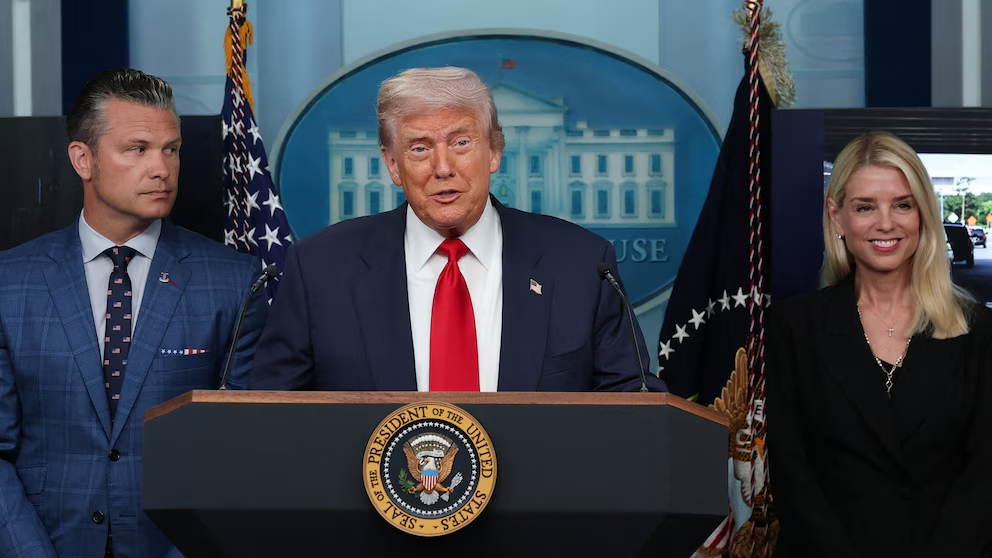
Speaking at a White House press conference, Trump declared a “public safety emergency” in Washington, D.C., invoking Section 740 of the District of Columbia Home Rule Act, which allows the president to assume control of the MPD for up to 30 days during emergency conditions. “Our capital city has been overtaken by violent gangs and bloodthirsty criminals,” Trump stated, vowing to “rescue” the city from what he called a “wave of lawlessness.” He appointed Attorney General Pam Bondi to oversee the police force, with Drug Enforcement Administration chief Terry Cole serving as acting MPD head.
The move has sparked intense controversy, with critics, including D.C. Mayor Muriel Bowser, calling it “unsettling and unprecedented.” Bowser, a Democrat, emphasized that violent crime in the city has been declining, noting a 35% drop in 2024 and an additional 26% decrease in the first seven months of 2025, according to MPD data. “We are not experiencing a spike in crime,” Bowser said at a press conference, highlighting that violent crime is at its lowest level in over 30 years. Despite her objections, Bowser acknowledged the president’s legal authority under the Home Rule Act and pledged to cooperate with federal officials.
Trump’s actions follow a high-profile assault on Edward Coristine, a 19-year-old former staffer of the Department of Government Efficiency (DOGE), during an attempted carjacking on August 3, 2025. The incident, along with other violent episodes—including the killing of a 21-year-old congressional intern—has been cited by Trump as justification for his intervention. However, city officials and federal data contradict Trump’s portrayal of a crime-ridden capital. According to the U.S. Justice Department, homicides dropped 32%, robberies 39%, armed carjackings 53%, and assaults with dangerous weapons 27% in 2024 compared to 2023—marking the lowest levels in decades.
The deployment includes 800 D.C. National Guard troops, with 100 to 200 supporting law enforcement through administrative, logistical, and visible presence tasks at any given time. The U.S. Army clarified that the troops are unlikely to carry weapons or have arrest authority, focusing instead on supporting local and federal law enforcement. Additionally, more than 450 federal officers from agencies like the FBI, DEA, ATF, and ICE have been deployed across the city, targeting high-traffic tourist areas and known crime hotspots.
Trump’s rhetoric has also raised concerns about his broader intentions. He signaled that other Democratic-led cities, such as Chicago, could face similar federal interventions. “If we need to, we’re going to do the same thing in Chicago, which is a disaster,” Trump said, echoing his campaign’s focus on “law and order” that often targeted majority-Black cities like Baltimore, Chicago, and Washington. This approach has drawn criticism for its racial undertones and for exaggerating crime statistics to justify federal overreach.
The takeover has reignited debates over D.C.’s limited autonomy under the Home Rule Act, which grants Congress and the president significant authority over the federal district. While Trump’s emergency powers allow temporary control of the MPD, a full federal takeover would require Congress to repeal the Home Rule Act—a move that would face strong opposition from Democrats. D.C.’s non-voting congressional delegate, Eleanor Holmes Norton, called the action a “historic assault on D.C. home rule,” warning of its impact on the city’s 700,000 residents, who overwhelmingly supported Vice President Kamala Harris in the 2024 election.
Trump also vowed to address homelessness, promising to clear encampments from federal parkland, though he provided no details on where displaced individuals would be relocated. Advocates for the homeless argue that the federal government lacks the authority to force people out of the city for lacking shelter. This follows Trump’s earlier executive order facilitating the removal of encampments on federal lands, marking a shift from previous policies prioritizing housing solutions.
The move comes amid other controversies, including a federal trial in San Francisco over Trump’s earlier deployment of National Guard troops to Los Angeles without California Governor Gavin Newsom’s approval. Legal experts anticipate potential court challenges to the D.C. takeover, with D.C. Attorney General Brian Schwalb calling the action “unlawful” and exploring legal options.
As National Guard troops begin patrolling D.C. streets and federal agents assume control of local policing, the nation’s capital faces a pivotal moment in its history. Trump’s aggressive stance on crime and governance has sparked a fierce debate over executive power, local autonomy, and the future of public safety in Washington, D.C.


